

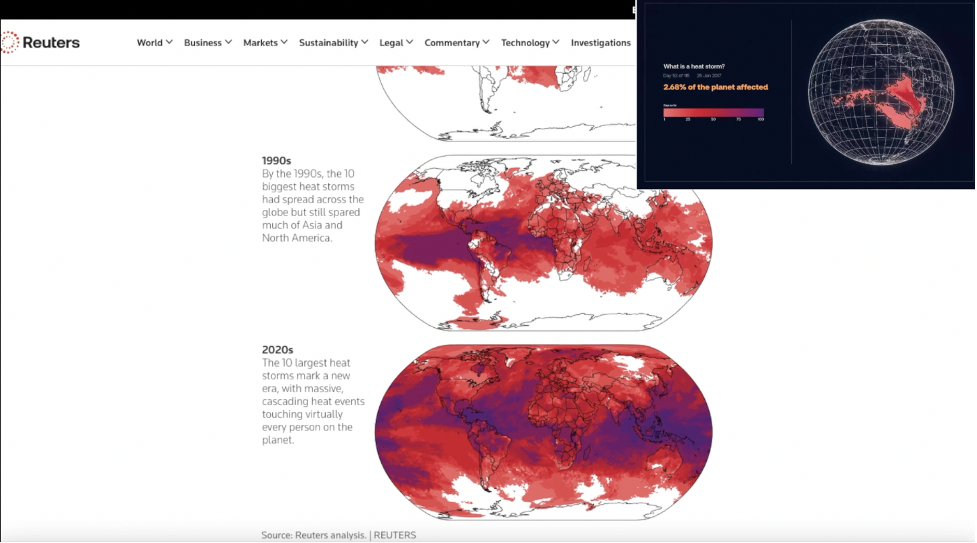
Day two-nine-seven of year one-two-zero-two-six.
Droughts have existed throughout human history and may have contributed to some of the steepest declines of civilizations in Mesopotamia, the Nile Valley, the Eastern Mediterranean, Mesoamerica, East Asia, and the North American Southwest. Various weather and health organizations have defined heat waves as abnormal periods of uncomfortably hot and/or humid weather typically lasting for two to three days. Ground temperatures hotter than ninety to ninety-five percent of the days, relative to historical local climate data, may be classified as heat wave days. Modern climatological literature similarly measures heat waves by comparing temperatures to historical percentiles. Reuters now defines a heat wave as five or more consecutive days of abnormally high temperatures and a heat storm as a major heat wave that at its peak covers at least 1% of the earth’s surface. Reuters recently reported increased frequencies and durations of heat storms in this century compared to last century. Improved reporting and tracking of heat waves and storms could aid heat-stress prevention and mitigation efforts in modern societies.
Sources:
American Meteorological Society. (2012). Heat wave. In Glossary of meteorology (2nd ed.).https://glossary.ametsoc.org/wiki/Heat_wave
California Independent System Operator. (2020). Summer loads and resources assessment. https://www.caiso.com
Hersbach, H., Bell, B., Berrisford, P., et al. (2020). The ERA5 global reanalysis. Quarterly Journal of the Royal Meteorological Society, 146(730), 1999–2049. https://doi.org/10.1002/qj.3803
IPCC. (2021). Climate Change 2021: The Physical Science Basis. Contribution of Working Group I to the Sixth Assessment Report of the Intergovernmental Panel on Climate Change (Chapter 11: Weather and Climate Extreme Events in a Changing Climate). Cambridge University Press.
National Weather Service. (2021). Heat safety: Definitions and advisories. National Oceanic and Atmospheric Administration. https://www.weather.gov/safety/heat-ww
Perkins, S. E., & Alexander, L. V. (2013). On the measurement of heat waves. Journal of Climate, 26(13), 4500–4517.https://doi.org/10.1175/JCLI-D-12-00383.1
Reuters. (2026a, October 20). The age of heat storms [Special report section]. Retrieved October 21, 2026, from https://www.reuters.com/investigates/section/heatstorms/
Reuters. (2026b, October 20). Meet the heat storm: 7 takeaways from our investigation that gave supersized heat waves a new name. Special Report: The Age of Heat Storms. https://www.reuters.com/investigates/special-report/climate-heatstorms-takeaways/
Reuters. (2026c, October 20). Special report: Giant “heat storms” are scorching the Earth. Reuters.https://www.reuters.com/sustainability/special-report-heat-storms-2026-10-20/
Seneviratne, S. I., Donat, M. G., Pitman, A. J., Knutti, R., & Wilby, R. L. (2016). Allowable CO2 emissions based on regional hot-spot climate change. Nature, 529(7587), 477–483. https://doi.org/10.1038/nature16542
Tamman, M., Welsh, B., McKenzie, P., Szymanski, C., Delgerjargal, D., Corey-Boulet, R., Coulibaly, L., Horwitz, J., & Faus, J. (2026, October 20). How (and why) we developed ‘The Age of Heat Storms’. Reuters.
World Health Organization & World Meteorological Organization. (2015). Heatwaves and health: Guidance on warning-system development (WMO-No. 1142). World Meteorological Organization. https://library.wmo.int/doc_num.php?explnum_id=3021
Appendix: Droughts Contributing to Societal Collapse
| Collapse Event | Era / Date | Region | Primary Mechanism & Impact | Scientific Sources |
| Akkadian Empire & Egypt’s Old Kingdom | c. 2200 BC | Mesopotamia & Nile Valley | Widespread crop failure, urban center abandonments, and royal decentralization caused by the 4.2-kiloyear megadrought. | Weiss et al. (1993); Lawrence et al. (2021) |
| Late Bronze Age Collapse | c. 1200–1150 BC | Eastern Mediterranean | Multi-century megadrought triggered region-wide agricultural failure, mass migrations (e.g., Sea Peoples), and systemic collapse of palace economies across multiple empires. | Kaniewski et al. (2013) |
| Terminal Classic Maya Collapse | c. AD 750–950 | Mesoamerica | Multi-year megadroughts superimposed on long-term drying led to reservoir failure, loss of divine royal authority, warfare, and urban abandonment. | Haug et al. (2003); Turner & Sabloff (2012); Evans et al. (2018) |
| Fall of the Tang Dynasty | c. AD 907 | East Asia | Weakened East Asian Summer Monsoon caused prolonged severe droughts, ruining grain supplies, crippling military supply lines, and triggering massive peasant uprisings (e.g., Huang Chao Rebellion). | Yancheva et al. (2007); Kempf et al. (2026) |
| Ancestral Puebloan Abandonment | c. AD 1276–1299 | North American Southwest | The 23-year “Great Drought” depleted rain-fed maize yields, forcing complete territory abandonments of cliff-dwellings (e.g., Mesa Verde) and regional migration. | Douglass (1929); Stahle et al. (2007) |
References
Douglass, A. E. (1929). The secret of the Southwest solved by talkative tree rings. National Geographic Magazine, 56(6),736–770.
Evans, N. P., Bauska, T. K., Gascón, F. A., Brenner, M., Curtis, J. H., & Hodell, D. A. (2018). Quantification of drought during the collapse of the Classic Maya civilization. Science, 361(6401), 498–501.https://doi.org/10.1126/science.aas9871
Haug, G. H., Günther, D., Peterson, L. C., Sigman, D. M., Hughen, K. A., & Aeschlimann, B. (2003). Climate and the collapse of Maya civilization. Science, 299(5613), 1731–1735. https://doi.org/10.1126/science.1080444 Cited by: 1407
Kaniewski, D., Van Campo, E., Guiot, J., Le Burel, S., Otto, T., & Baeteman, C. (2013). Environmental roots of the Late Bronze Age crisis. PLOS ONE, 8(8), e71004. https://doi.org/10.1371/journal.pone.0071004 Cited by: 370
Kempf, M., Depaermentier, M. L. C., Spengler, R. N., III, Frachetti, M. D., Chen, F., & Ju, J. (2026). Hydroclimatic instability accelerated the socio-political decline of the Tang Dynasty in northern China. Scientific Reports, 16(1), Article 10423.
Lawrence, D., Palmisano, A., & de Gruchy, M. W. (2021). Collapse and continuity: A multi-proxy reconstruction of settlement organization and population trajectories in the Northern Fertile Crescent during the 4.2kya Rapid Climate Change event. PLOS ONE, 16(1), e0244871. https://doi.org/10.1371/journal.pone.0244871 Cited by: 105
Stahle, D. W., Fye, F. K., Cook, E. R., & Griffin, R. D. (2007). The paleoclimate record of severe droughts in North America. GSA Today, 17(12), 4–10. https://doi.org/10.1130/GSAT01712A.1
Turner, B. L., & Sabloff, J. A. (2012). Classic Period collapse of the Central Maya Lowlands: Insights about human–environment relationships for sustainability. Proceedings of the National Academy of Sciences, 109(35), 13908–13914.https://doi.org/10.1073/pnas.1210106109 Cited by: 351
Weiss, H., Courty, M. A., Wetterstrom, W., Guichard, F., Senior, L., Meadow, R., & Curnow, A. (1993). The genesis and collapse of third millennium north Mesopotamian civilization. Science, 261(5124), 995–1004.https://doi.org/10.1126/science.261.5124.995
Yancheva, G., Nowaczyk, N. R., Mingram, J., Dulski, P., Schettler, G., Negendank, J. F. W., Liu, J., Sigman, D. M.,Peterson, L. C., & Haug, G. H. (2007). Shifting Intertropical Convergence Zone scans during the past 15,000 years and the collapse of the Tang Dynasty. Nature, 445(7123), 63–67. https://doi.org/10.1038/nature05453


