
If you’re having difficulty differentiating AI from real people and real posts from advertisements, you’re not alone. Artificial intelligence (AI) and advertisements are almost everywhere these days. I recently read a post that discussed a research paper but never provided a link to it.
- Naive
As I read the really well-written post, I became skeptical. Is this AI? Where’s the link to the paper?
So I posted the following comment:
Me: “Is this a marketing advert or an educational post? Where is the link to the study?”
The author replied.
Post Author: “Try asking nicer. Or google it”
Ouch! I didn’t think my comment warranted such a curt reply, but maybe I missed something?
Thanks to Google, I found the article and settled on the following reply:
Me: “Apologies. I didn’t mean to be rude. Excellently written. https://www.nature.com/articles/s41561-026-01928-z“
And I received a nice reply in return.
Post Author: “Ahhh 🙂 appreciate it! And thank you for the support”
Phew! One less bridge burned. Is it just me or are those things more frail and combustible these days?
I reflected on the exchange. Why didn’t the author include a link?
- Rumor has it (google) that social media site algorithms tend to favor posts that keep users on the site. LinkedIn and Youtube now have these weird internal links that do not take you to the actual URL or website you copied into your post but instead take you to a different link embedded in their website. I know this because when I try to copy a published LinkedIn post to share it to Bluesky or Substack, the links no longer work. They just populate into the post as nonfunctional jumble of symbols and numbers.
So, the author was probably trying to get more attention on her post. External links make posts less viral and limit impact/reach. I think the author expected me to intuit this.
My ignorance only explains some of the author’s annoyance. Why did the author perceive my comment as rude?
- My comment was curt and assumed the post was an advertisement or an educational post. Calling out the post as an advert may have put the author on the defensive, but the annoyance, again, could have been more subtle. I didn’t leave open the possibility that the post was both an advertisement and educational.
We live in a world that puts a premium on affordable and entertaining content. The author’s post exists in a capitalistic attention economy. Throwing links and free content into altruistic educational posts while making no effort to sell your services is not a sustainable business strategy.
You’re working hard to strike a balance between growing your business/brand and do something good for society. You’re researching the rules and gathering the information. Your double-checking your sources and revising your drafts. You’re aware of the social media algorithms because you’ve learned their ways through steady study, trial, and error. Now some naive person assumes you need to educate or market – not do both – and be willing to sacrifice growth and attention for the momentary convenience of your virtual audience. I might be annoyed too!
- Naive
- Defensive
This recent LinkedIn exchange reminded me of some of my own bouts of defensiveness. Two of those moments occurred when a friend called me “uncultured” and “a square”. I know these moments got to me because I often think back to and feel resentful of those labels.
When my friend called me “uncultured”, I responded with something like “I’ve been to places you’ve never been and seen things you’ve never seen…” Another friend who was listening into the conversation commented “Whoa, somebody is defensive…” My other friend just smiled at me like my defensiveness had just proved her point. It had.
- Naive
- Defensive
- Uncultured
You may be uncultured if you…
- …are only fluent in one language,
- have traveled some but not enough to really understand and immerse yourself in other cultures,
- often do not care about cultural norms and taboos when visiting other places,
- are quick to criticize perceived faults and slow to praise obvious strengths of other nations,
- think too much about being cultured, and…
- …struggle to live in the moment.
If you have taken risks but not really brave or great ones, or if most of what you do is pre-calculated to minimize risk, you may be a square.
Square:
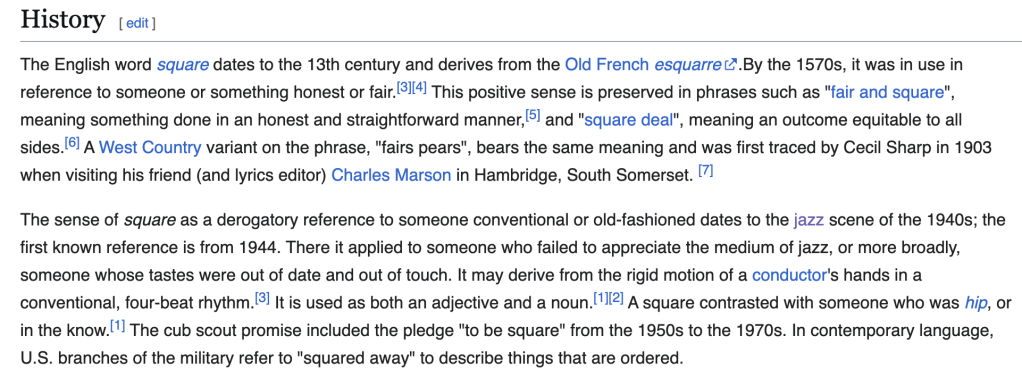
So, what is an uncultured square to do in a rapidly-evolving world full of triangles, rectangles, pentagons, hexagons, and a myriad of others shapes?
Learn. Adapt. Take some risks.
Look it up yourself. Try something new. Don’t be square?
If I could go back to that moment and check my rage-response to being labeled “uncultured”, I would. Much of my resentments may be born of loneliness and discontent. Who am I trying to impress with all that cultural awareness?
Constantly adapting to the cultures of those around you may be another way not to find yourself. But, if you are willing to learn, adapt, and try new things, you may find some of those things appeal to you at a fundamental level. The essence of who you are my be hiding in some of those uncomfortable unknowns.
In the end, finding yourself may mean striking a balance between spending time with yourself and finding yourself in others. No man is an island (Merton, 1955). We’re more like continents, peninsulas, and archipelagoes.
Whatever shape you are, you can keep learning, growing, and finding your place in this crazy world. Keep on keeping on. And for all the people out there who know they’re squares, you can decide for yourself if you want to try to take a new shape or if “it’s hip to be square”…