


One of my teachers had a habitual imperative, “Show me the data.” He wanted information that backed up your statement in the absence of information that disproved it. He would not trust your statements without it.
Why does this kind of skeptical curiosity currently feel so rare? Is it too hard? Are we lazy? Do we lack the courage and fortitude to question our strongest convictions? Or, are we just not exposed to it? Do we need more skeptics?
Skepticism vs. Epistemology:
Skepticism is doubt. It’s also a philosophical theory that questions the existence of absolute knowledge.
Epistemology is the study of knowledge. It’s concerned with veracity. Epistemology asks, “What is true?”
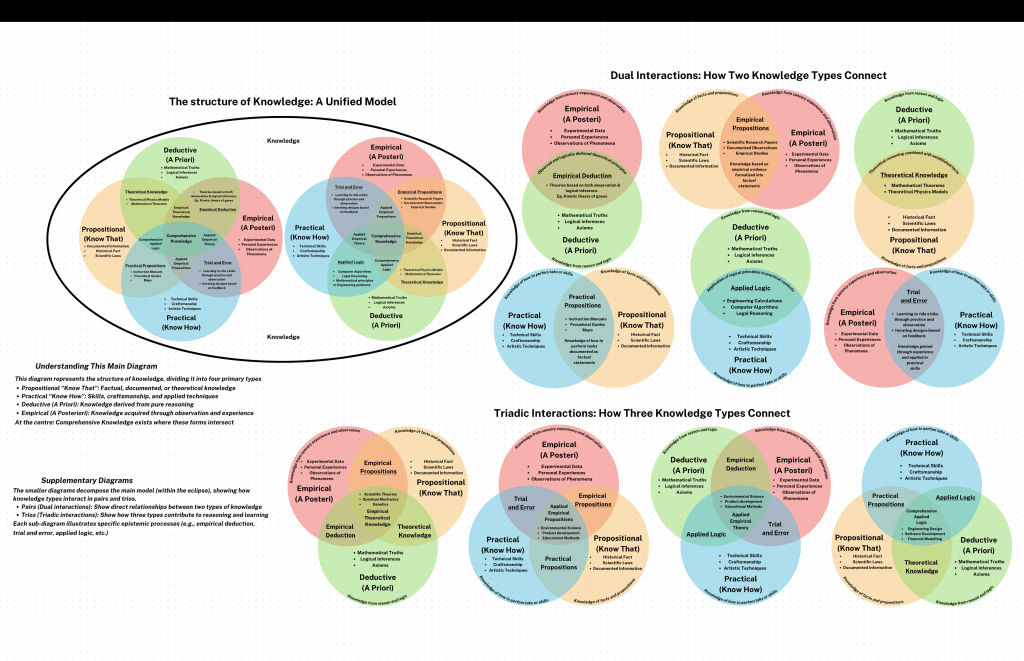
Rabbit Hole 1: Empiricism (“I know __ because…”)
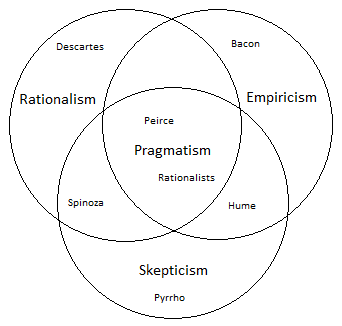
While Skepticism can be considered a subcategory of Epistemology, it focuses on the absence of knowledge more than the acquisition of knowledge. Skeptics seek not to prove knowledge but to disprove it. Skeptics falsify.
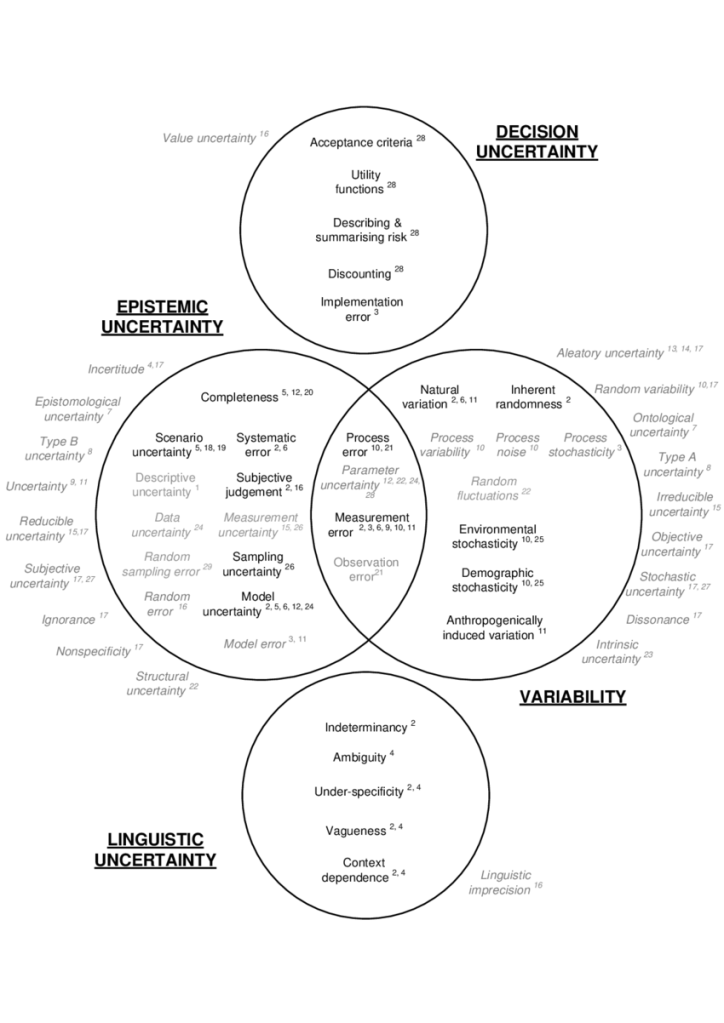
Rabbit Hole 2: Skepticism (“I don’t know __ because…”)
Epistemology is a search for knowledge. Epistemology asks, “What is true and how can we know?”
Skepticism is the questioning of knowledge itself. Skepticism asks, “What is not true, and what don’t we know?”
Epistemologists seek knowledge. Skeptics test it. Epistemology seeks proof. Skeptics focus on falsification.
For skeptics, the absence of falsifiability removes a statement from consideration. If no evidence can be presented to empirically disprove a statement, it ceases to be testable. It is no longer a hypothesis. It belongs to the realm of the supernatural and whatever God(s) may be. Mortal skeptics do not claim evidence in the absence of falsification.
Karl Popper’s idea of falsification is entirely Lindy-compatible; it actually requires the operation of the Lindy Effect… Ideas need to have skin in the game. You know that the idea will fail if it is not useful, and can be therefore vulnerable to the falsification of time… The more an idea has been around without being falsified, the longer its future life expectancy.” – Nassim Nicholas Taleb (2017)
Falsifiable statements withstanding robust empirical tests over a long period of time are only as trustworthy as their ability to withstand more and more experimental and reasonable historical efforts to disprove them. As Nassim Taleb (2017) writes, “The more an idea has been around without being falsified, the longer its future life expectancy.” That’s healthy skepticism in a nutshell. If you’re interested in digging deeper into the philosophy of skepticism, you can read the works of Nassim Taleb, Sextus Empiricus, David Hume, Montaigne, and other skeptics.
Similarly, Missouri’s nickname is the “Show Me State”. While there are multiple origin stories to this statement, the most flattering one may be a quote from Willard Vandiver after showing up underdressed for a formal event. He joked that another attendee stole his suit then exercised some self-deprecating humor about his home state stating, “I’m from Missouri. You have to show me.”
“I’m from a state that raises corn, cotton, cockleburs and Democrats, and frothy eloquence neither convinces nor satisfies me. I’m from Missouri. You have to show me.”
– Representative Willard Duncan Vandiver of Missouri (Britannica, 2025)
Vandiver wasn’t advocating for you or the people of the State of Missouri to start exercising more skepticism, but I am. The internet can make rational and empirical dialogue and debate more accessible. It can also drown it in a cacophony of foolish noise. Why are we not elevating more mutually-beneficial and educational discussion?
What would happen if we took it upon ourselves to show not tell? What if we politely ask for a link to the data supporting a person’s point of view? What if we held ourselves to higher standards of [empirical] evidence? Why don’t we take a lesson from the skeptics and turn the Show Me State motto into a mantra for empiricism?

Show me
Photo by Chris Duan on Pexels.com
Sources:
Britannica Editors (2025, June 13). Why Is Missouri Called the Show Me State?. Encyclopedia Britannica. https://www.britannica.com/story/why-is-missouri-called-the-show-me-state
Epistemological diagram of knowledge. (n.d.). reddit.com. Retrieved February 1, 2026, from https://www.reddit.com/r/epistemology/comments/1jo45b5/epistemological_diagram_of_knowledge/#lightbox
Hayes, Keith & Regan, H.M. & Burgman, Mark. (2007). Introduction to the concepts and methods of uncertainty analysis. Environmental Risk Assessment of Genetically Modified Organisms, Volume 3: Methodologies for Transgenic Fish. 188-208.
Taleb, N. N. (2017, January 9). An Expert Called Lindy. medium.com. Retrieved February 1, 2026, from https://medium.com/incerto/an-expert-called-lindy-fdb30f146eaf
What is Rationality? (2020, March 18). Retrieved February 1, 2026, from https://atlaspragmatica.com/what-is-rationality/

 Deliberating Truth