

Tomorrow (Monday, August 18th, 2024) will be the second 2025 White House meeting between the President of the United States and the President of Ukraine. Trump & Zelenskyy 1.0 didn’t go so well. There were public arguments about security guarantees, mineral rights, and what can be expected from the President of Russia, Vladimir Putin. But unless at least one of these leaders has some serious tricks up their sleeve, I think we can expect more of the same.
LOW
(Chance of a Sustainable Russia-Ukraine Peace Deal in 2025)
Why do I think there is a low chance of a long-term solution to the Russia-Ukraine War in 2025?
(1) Conflicts Can Age Like Books: The “Lindy Effect” May Apply Here
- The War started in 2014 not 2022…
- It’s easy to think these countries have only been at war since 2022 when Russia invaded the Donetsk and Luhansk oblasts of the Donbas region of Ukraine and attempted to push all the way to the Dnieper (Dnipro) River that runs through Ukraine’s capital city of Kiev. But these countries have really been fighting since masked and unidentified Russian soldiers invaded Crimea on February 20, 2014 and militarized separatist movements sprang up in the Donbas in April of 2014.
- The year 2022 is when a much larger portion of Western nations started supporting Ukrainians and paying attention to the Russia-Ukraine conflict. Since the conflict is 11 years old, it is more likely to continue for another 10 years. Think of the U.S. War in Afghanistan (2001-2021), or for more even context, google the “Lindy Effect* or click on the arrow below…
*What is the Lindy Effect? (According to a Goggle “AI Overview”, 2025)
“The Lindy effect primarily applies to things that don’t decay or have a limited lifespan in the same way that living organisms or perishable goods do. Examples include ideas, technologies, books, or even cultural practices. The effect suggests a proportional relationship between current age and remaining lifespan. A technology that has been around for 10 years, for instance, is predicted to last another 10, while one that has been around for 100 years is expected to last another 100.”
(2) Death & Destruction: Harm Hurts & Often Leads to Hate
- Millions of people have been directly harmed by this war, tens of millions indirectly.
- Millions of people have been forced to permanently leave their homes. Hundreds of thousands of people have been severely wounded and suffer disabilities or chronic health problems as a result of their injuries. And tens of thousands have been killed in the fighting or missile attacks. That’s millions of offended people on both sides…
- It’s not complicated. Just think about how you would feel if someone forced you to flee your hometown or country or shot you or blew off one of your limbs or killed one or more of your friends or family members. It’s understandably difficult to turn around and negotiate peace with the people who have harmed you. And that’s only the “death” part.
- The “destruction” or agricultural, industrial, financial, and economic costs of this war also serve as intractable grievances and enormous barriers to negotiations.
- For information on Russia-Ukraine War casualties, click on the arrow below…
Number of Russia-Ukraine War Casualties (injured/mobidity + dead/mortality)…as of Aug, 2025
“The estimate aligns with a recent study by the US-based Centre for Strategic and International Studies (CSIS), which puts Russian military deaths at up to 250,000 and total casualties, including the wounded, at over 950,000. Ukraine has suffered very high losses as well, with between 60,000 and 100,000 personnel killed and total casualties reaching approximately 400,000. (Guardian, 2025)”
A Google “AI Overview” of “estimated total displaced ukraine war”: “As of July/August 2025, an estimated 9 to 10 million people have been displaced by the war in Ukraine, with approximately 4 million internally displaced within the country and nearly 6 million refugees living abroad, according to data from the International Organization for Migration (IOM) and UNHCR. These figures represent the vast majority of the Ukrainian population, forcing millions to flee their homes in search of safety”
(3) Historical Context: Correlation Not Causation… but how strong is that correlation?
- There have been numerous conflicts and atrocities in Ukraine over the past 500 years…
- Whether the Cossack rebellions of the 16th, 17th, and 18th centuries, the Crimean war of the 19th century (1853-1856), the early 20th century World War Era civil conflicts, or the 21st century Russo-Ukrainian War – the peoples who populated the lands of modern Ukraine witnessed a lot of violence and suffering over the last five centuries.
- The pogrom atrocities of the late 19th and early 20th centuries, the holocaust in Ukraine (1941-1944), the Massacres of Poles in Volhynia and Eastern Galicia (1943-1945), and the Bucha massacre in 2022 are some examples of war crimes (See Human Rights Watch & United Nations for more information on the 2022 events in Bucha)
- For more info, search “conflicts in Ukraine over last 500 years” or click the arrow below…
Conflicts in Ukraine Over the Last 500 Years (According to a Google “AI Overview”, 2025)
“Over the last 500 years, the territories of modern-day Ukraine have been the site of numerous conflicts, including the Cossack uprisings against the Polish-Lithuanian Commonwealth (17th century), Russian expansionism and the eventual partitions of Poland (18th century), the Russian Civil War and the Ukrainian War of Independence (early 20th century), and the Second World War and Soviet-German occupations. More recently, Ukraine’s transition to independence in 1991 was followed by the 2014 annexation of Crimea by Russia and the subsequent ongoing Russo-Ukrainian War.”
A Google “AI Overview” of “atrocities in ukraine over last 500 years”: “Here is a summary of some of the significant atrocities in Ukraine’s history over the last 500 years, acknowledging that this is not an exhaustive list: 17th Century Khmelnytsky Uprising (1648-1657)… 18th Century Cossack uprisings & Koliivshchyna (1768-1769)… Early 20th Century (Post WWI and Russian Revolution) Pogroms (1917-1921), Civil War and Famine (1918-1921), & NKVD Prison Massacres (1941)… Soviet Era (1922-1991), Holodomor (1932-1933), Soviet political repressions, & Ethnic Cleansing and Forced Deportations… World War II (Nazi Occupation) The Holocaust in Ukraine & Nazi war crimes (1941-1944)… Post-Soviet Era (Current Conflict with Russia) [potential or confirmed] War crimes [such as] the Bucha massacre, sexual violence, extrajudicial killings, torture, looting, deportation of children, and deliberate targeting of civilians and civilian infrastructure.”
Friday, August 15th, 2025: President Trump (1) maintained open communications/negotiations and (2) legitimized President Putin when he met with him in Anchorage, Alaska (United States) without enforcing warrants for President Putin’s arrest.
Saturday, August 16th, 2025: Phone calls between European leaders, President Zelenskyy, and Executive Branch staff set the schedule and pretext for a meeting with President Trump & his team.
Sunday, August 17th, 2025: The U.S. Secretary of State Marco Rubio touted President Trump’s recent efforts while focusing on the need for concessions on one or both sides of the Russo-Ukraine conflict.
Monday, August 18th, 2025: President Trump & his staff will reportedly meet with President Zelenskyy, German Chancellor Friedrich Merz, French President Emmanuel Macron, British Prime Minister Keir Starmer, Italian Prime Minister Giorgia Meloni, Finnish President Alexander Stubb, and European Commission President Ursula von der Leyen.
For the sake of all the world and especially all of the people who call Eastern Europe home, I hope these negotiations go well. But, our shared history reminds me not to hold my breath…
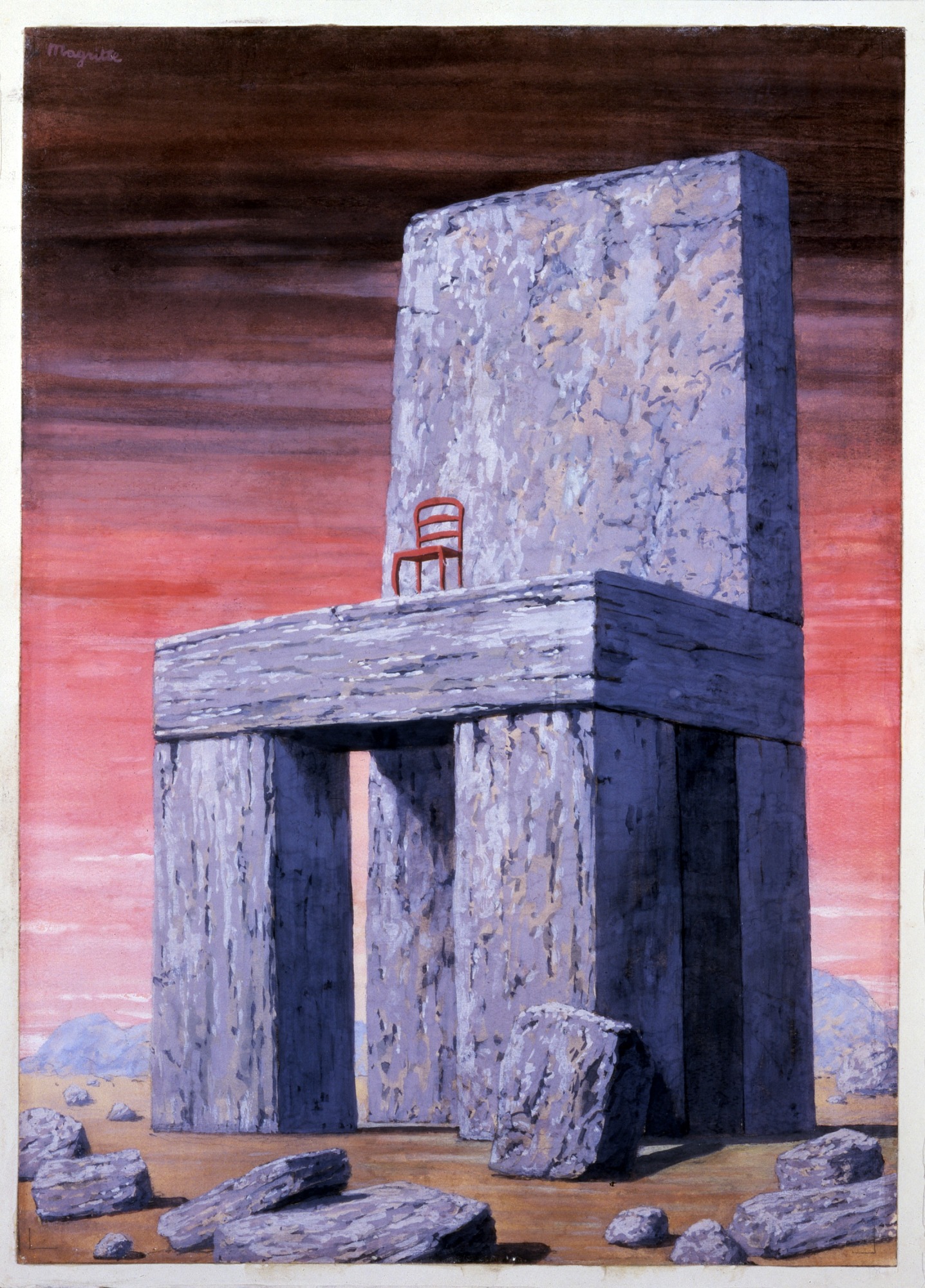
“Those who cannot remember the past are condemned to repeat it.”
– George Santayana, The Life of Reason, 1905.

René Magritte, “Those who cannot remember the past are condemned to repeat it.”–George Santayana, The Life of Reason, 1905. From the series Great Ideas of Western Man., ca. 1962, gouache and pencil on paper mounted on paperboard, sheet: 13 3⁄8 x 9 1⁄2 in. (34.0 x 24.2 cm), Smithsonian American Art Museum, Gift of Container Corporation of America, 1984.124.194

 Deliberating Truth