

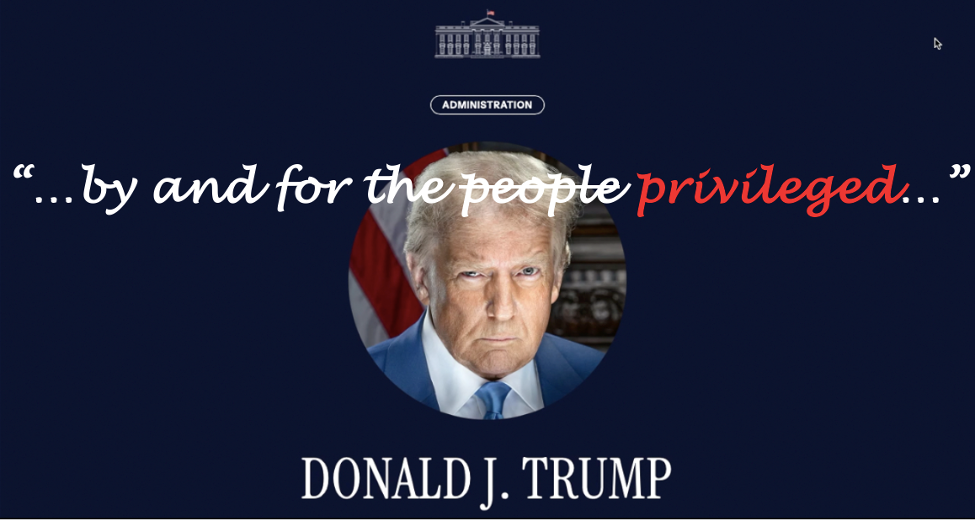
If you want to discover what any organization is really about, it may be best to take some colloquial advice and just “follow the money”. Unfortunately, many taxpayers never do.
Public businesses and nonprofit organizations have stricter rules for financial reporting. Private and government organizations often neglect the financial details in annual reports if they have them at all. So, even if a taxpayer wants to “follow the money”, he or she will quickly lose the money trail at the edge of the government forrest. Without insider information, U.S. taxpayers cannot see the trees of government offices in the forrest of government spending. When it comes to outside observation of government budgets, the forrest is all you can see. And at $36 trillion in debt, the forest of U.S. government financials is not looking good.
Don’t believe me? No worries. Here’s a link to some government financial reports. Decide for yourself. Do you see trees or a forrest? How does that forrest look to you?
“Tell me the difference between stupid and illegal and I’ll have my wife’s brother arrested.” – Jared (played by Ryan Gosling), The Big Short (2015)
Like Jared in The Big Short, I’m skeptical about the difference between stupid and illegal. Jared suggests his brother-in-law will only be arrested when his stupidity is labeled as illegal. So, can government budgets also be remarkably stupid without being classified as illegal?
Two billionaire businessmen, three if you include the President, have proposed large government spending cuts via a new Department Of Government Efficiency (DOGE). One stated as much as $2 trillion dollars can be cut from the annual budget. Both have suggested it may be a messy process that includes the removal of many government employees.
But who? Will people who lay-low, kiss-up, or punch-up be most likely to keep their jobs? Is DOGE more about consolidating power or cutting wasteful spending?
While we can’t see the party-affiliations of government agency employees, we can see partisan public opinion polls of government agencies. These public opinion survey results suggest any partisan executive branch could seek to consolidate power by trimming the government agencies that constituents rate poorly. If you want to use public opinion to gain power, why not slash government budgets in the name of “efficiency”? Why not funnel some of those federal funds to your more “efficient” companies?
Party loyalty could be a leading factor when choosing what agencies, offices, and positions will be on the chopping block.
Whatever happens to the government in these next few years, it seems unlikely that (1) $2 trillion of spending cuts will be realized and (2) that government offices will begin publishing detailed annual financial reports.
The U.S. public (i.e. constituents, citizen voters and residents) could begin to demand more fiscal transparency from the U.S. government. We can label ourselves or others all day long: lazy free-riders, yes-people & kiss-ups, woke social justice warriors, or whatever other stereotypes we can conjure. But these labels are just distractions if we can’t “follow the money” of taxpayers. “The proof is in the pudding” and “the devil is in the details”.
Here’s the takeaway: this nation’s people would be better able to hold their government accountable if its offices were required to publish itemized annual financial reports. “Top-secret” spending could simply be labeled as “top-secret”. And, of course, there would be a lot of it. But enforcing itemized financial reports could drastically reduce wasteful spending through public accountability. What we don’t know can hurt us, and it often does.
One of the current realities of the U.S. government is far-too little accountability. Many may disagree, but what do they make of the nation’s historically low levels of trust in its government? The DOGE seems unlikely to mandate itemized financial reports across government agencies. The continued accumulation of power and financial capital seems a more likely goal of these billionaire bureaucrats.
If past behavior is a decent indicator for future behavior, these billionaires will be unconcerned with more perfect government representation and more interested in maximizing the efficiency and effectiveness of their egos, organizations, stock portfolios, and net worth. I would be happy to see this prediction disproved. But as one of my professors used to say, “Show me the data.” Since itemized financial data is absent and government spending is not transparent, the nation’s fate will continue to depend on the long-suffering heroes and better angels of our civil service.
Mandatory itemized financial reporting across government offices and agencies would not solve all of the nation’s ills. But it could provide more public pressure for fiscal frugality at the federal level. At the very least, it would demonstrate the apathy for fiscal responsibility among the general public and provide less of an excuse for government scapegoating.
So, if the only thing the Department Of Government Efficiency manages to do is enforce the publication of honestly detailed annual financial reports, it will have made a tremendous contribution to the U.S. government. But, until that day comes, I’ll leave you with this… Tell me the difference between transparent integrity and trust and I will shut up about itemized financial reports.

 Deliberating Truth