

The Hedgehogy Fox:
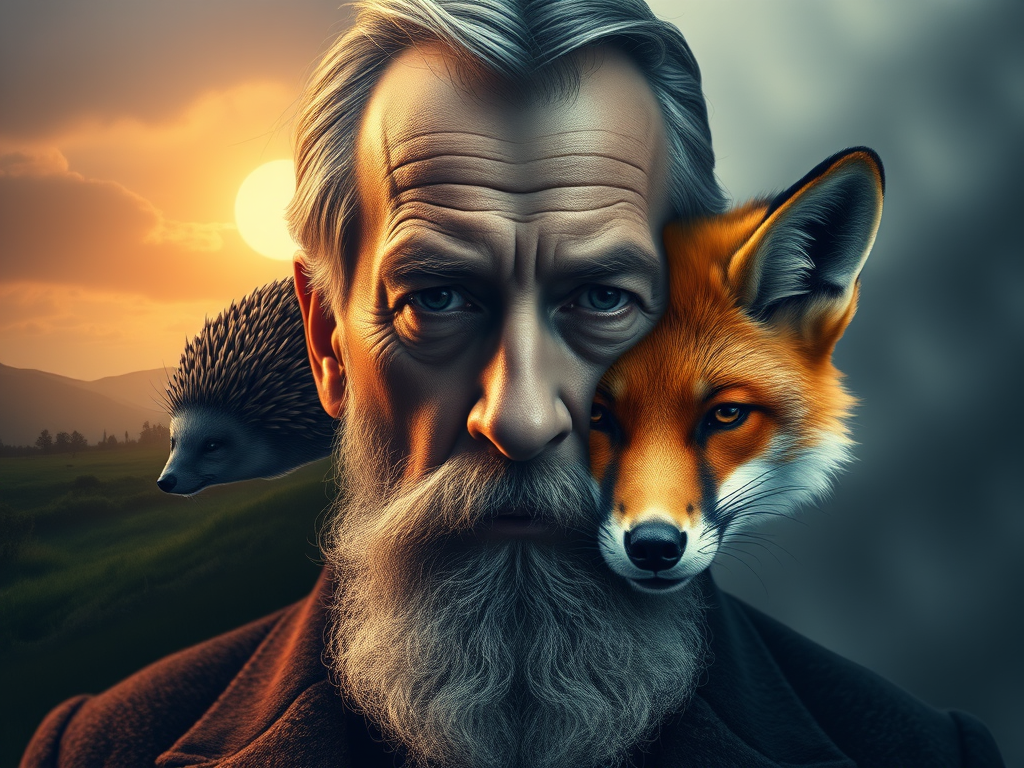
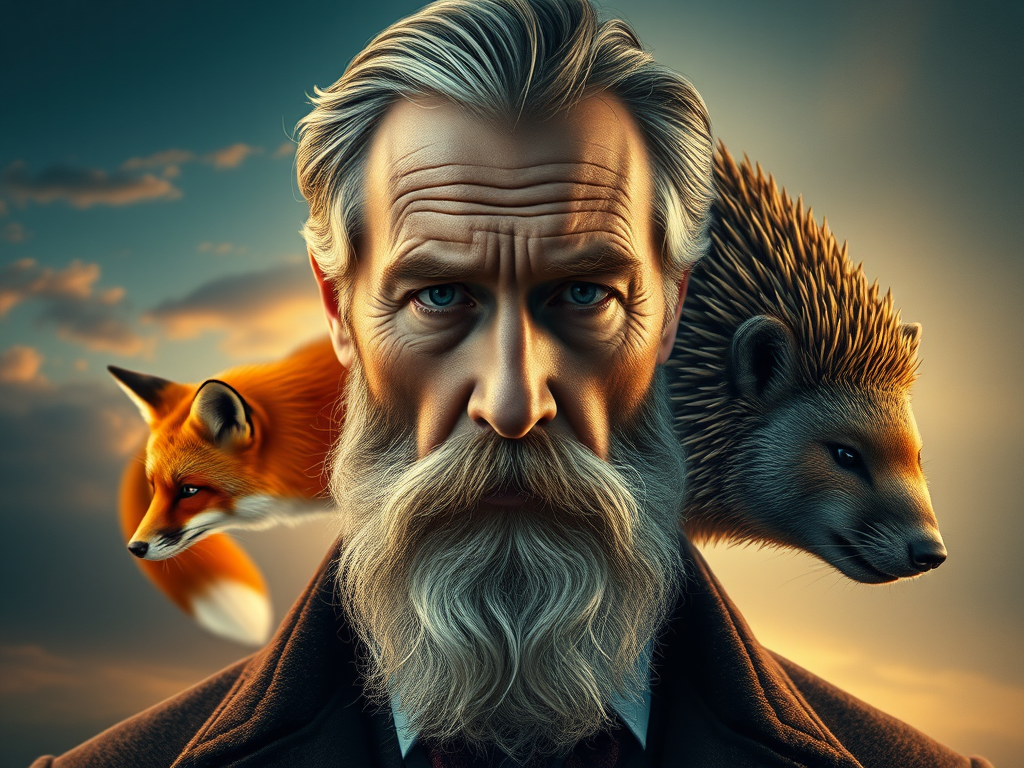
In the Hedgehog and the Fox (1953), Isaiah Berlin speculates on Leo Tolstoy’s inner turmoil. The famous Russian author self-sabotaged his own happiness (Valiunas, 1989). And Berlin suggests Tolstoy’s insatiable desire to find life’s unifying and absolute truth or principle may have been one of the reasons for his persistent discontent.
Tolstoy was popular, wealthy, and gifted. He had many lovers and children. He lived to the age of 82 years. He was both a youthful aristocrat and handsome soldier. He was a philanderer and a family man. He was an open-minded artist and an Orthodox Christian. As much as any man can, he seems to have had the best of both worlds.
But Berlin focuses on Tolstoy’s internal conflict between open-mindedness and absolutism. He credits Tolstoy’s embrace of skepticism and falsification while admiring his persistent search for an ultimate truth. Berlin ends his essay somberly highlighting the intractable discontent of Leo Tolstoy.
A Brain in Conflict:
Reading Berlin’s interpretation of Tolstoy reminded me of Iain McGilchrist’s The Master and His Emissary (2009) which discusses potential conflicts between the left and right hemispheres of the human brain. The brain’s right hemisphere is depicted as the master and the left hemisphere as its emissary. The emissary (left hemisphere) is to serve its master (right hemisphere):
“The right hemisphere’s disposition is tentative, always reaching painfully (with ‘care’) towards something which it knows is beyond itself. It tries to open itself (not to say ‘no’) to something that language can allow only by subterfuge, to something that reason can reach only in transcending itself; not, be it noted, by the abandonment of language and reason, but rather through and beyond them. This is why the left hemisphere is not its enemy, but its valued emissary. Once, however, the left hemisphere is convinced of its own importance, it no longer ‘cares’; instead it revels in its own freedom from constraint, in what might be called, in a phrase of Robert Graves’s, the ‘ecstasy of chaos’. One says, ‘I do not know,’ the other says, ‘I know – that there is nothing to know.’ One believes that one cannot know: the other ‘knows’ that one cannot believe.”
McGilchrist is concerned with the left hemisphere’s assertion of mastery. Is the brain’s left hemisphere designed to specialize? Does the left hemisphere form habits? Habituation may accelerate the completion of tasks through division of labor. But over-habitualization can lead to ignorance: “I know – that there is nothing to know”. Is this what happens when the emissary (left hemisphere) seeks to become the master (right hemisphere)?
The Master and His Emissary is fun lens with which to examine Tolstoy. One of the most famous writers/authors of all time apparently suffered chronic discontent. He sought and wrote about happiness in a myriad of ways. Yet he never seemed to obtain it.
Some of Tolstoy’s traits appear more characteristic of the brain’s right hemisphere. Tolstoy displayed a high level of openness to experience as he seemed to resent claims to absolute truth. He wrote vivid scenes as if he was seeing them for the first time.
Yet he was confident in his intellectual abilities and he stubbornly categorized. As a voracious reader and writer, he knew a lot of things about a lot of things. He used his brain’s left hemisphere to divide and conquer the ideas and tasks he was interested in.
Tolstoy’s mind was conflicted. His desire for happiness at times appeared inseparable from his desire for truth. He refused to stake a claim to absolute truth but also refused to quit his pursuit of it. Was this man’s right hemisphere always in control? Or was the left hemisphere attempting to usurp its master?
It’s possible that Isaiah Berlin’s hedgehog stereotype is similar to McGilchrist’s categorization of the brain’s left hemisphere. Are fox-like people more right-brain dominant? Was Tolstoy’s brain divided between the open-minded master and fox-like skeptic on one side and the grasping emissary and hedgehog-like absolutist on the other?
I don’t know. But I want to know. Is that a problem?
The Hedgehog Problem I:
The hedgehog versus fox categorization is popular. And Berlin may have regretted his use of it. But we humans love our dichotomies. And whether or not we can be confident in the hedgehog-like left hemisphere and fox-like right hemisphere, we can be confident in the tendency for people to latch onto these categories and in the role of specialization in modern societies.
Most humans may be generalists. But advertising yourself as a specialist seems to be more profitable. Many innovators, subject matter experts, and problem solvers may be generalists, but marketing is about building brands and telling compelling stories. And every story needs a central theme. Since specialists already have a theme, they may be able to build a brand faster than generalists. But the life of a brand is not solely dependent on the speed of its development.
In Range (2019) Epstein discusses the utility of deferred specialization as it applies to athletes and artists. He argues that those who are trained in multiple sports or instruments (e.g. cross-training) from a young age into their adolescence and young adulthood may be more likely to excel as professional artists and athletes. While the complete argument is more nuanced, it’s clear that Epstein sees over-specialization as a problem. McGilchrist and Berlin appear to share this hardly radical sentiment. Of course, we should not become overly-obsessed over any one person, action, or thing.
But seeing the hedgehog versus fox analogy as a specialist verse generalist question misses a central point of Berlin’s essay. Epstein is arguing for generalization before specialization. But Berlin seems to remind readers to remain wary of biases, dogmas, and ideologies. Our most deeply held beliefs and convictions, even the ideas of absolute truth or absolute relativism, may be wrong.
One can say ‘I don’t know’ or ‘I know’ and leave it at that. Or, one can say ‘I may know’ or ‘I may not know’ and ask another question. The former tends to end the conversation. The latter keeps conversations going.
Utopian, dogmatic, or ideological pursuits all seek the same things: deliverance, dominance, and destinations. If we wish to eliminate all pain and doubt, it’s easy to imagine an answer lies hidden just ahead – if we only have the will to grasp it. But the reality is that we are all on a journey that – by all appearances – requires death. There is no way to peer past it from a distance. Like the event-horizon of a black hole, we can only speculate about what lies beyond death.
It may be wise to accept death as a necessary part of life. And, perhaps, that was part of what Berlin was trying to say about Tolstoy. We live our lives in the shadow of death. We currently know of no way to escape that fate. And seeking an escape from death may be akin to seeking an escape from life itself. Living in constant fear of death is no way to live.
Epstein speculates on the detriments of hyper-specialization. McGilchrist hypothesizes that our modern society may have a not-so-insignificant left-hemisphere problem. And although Berlin seems to shy away from a condemnation of hedgehogs, his essay’s conclusion suggests obsessive pursuits of absolute truths or principles may result in unhappy endings.
Isaiah Berlin’s essay is an effort to better understand and explain Tolstoy. The man was conflicted. Were the expectations he had for himself or his life too high? Was his unhappiness the inevitable result of some Freudian childhood trauma? Or, was he just the unlucky recipient of an inherited depression or biochemical imbalance in his brain?
The Nonviolent Skeptic:
I don’t know. But I am also a skeptic who wants to find an absolute truth or principle that makes the world a significantly better place. Violence and arms races appear to sustain themselves. And, nonviolence, like mutual nuclear dearmament, seems to be a more reasonable path to peace. Tolstoy wrote about nonviolence in The Kingdom of God is Within You (1894):
“…when force is used against one who has not yet carried out his evil intent, I can never know which would be greater – the evil of my act of violence or of the act I want to prevent… And what an immense mass of evil must result, and indeed does result, from allowing men to assume the right of anticipating what may happen.”
This agrees with Berlin’s characterization of Tolstoy:
“Like Augustine, Tolstoy can say only what it is not. His genius is devastatingly destructive. He can only attempt to point towards his goal by exposing the false signposts to it; to isolate the truth by annihilating that which it is not – namely all that can be said in the clear, analytical language that corresponds to the all too clear, but necessarily limited, vision of the foxes.”
Tolstoy is using a stereotypically right hemispheric way of negation to discover truth. The idea is to seek understanding through ruling out or disproving your ideas. Call it Talebian via negativa, Popperian falsification, Aquinian via negationis, de-mellian neti, neti – etcetera. Negation asserts it is more productive to disprove than prove. Falsification relies on tests like time, chance, and pressure to reveal probability and confidence.
And yet, Tolstoy the skeptic promotes a vision of true, nonviolent, Christianity. Is that a problem? If Christian nonviolence is wrong, yes. If your goal is happiness in this life, probably.
Nonviolent Christianity may have worked well enough for Tolstoy, Adin Ballou, and Dorothy Day who all died in their eighties. But what about Martin Luther King?
At 39 years old, MLK just failed to live just half the life Tolstoy who died at the age of 82 years. Even Tolstoy could have spent the second half of his life enjoying the fruits of his earlier labors. Instead, he turned down easy money, fought with his wife, and philosophized about Christian nonviolence. This former soldier of the Crimean War and friend of the Russian aristocracy dedicated his later years to nonviolent Orthodox Christian Anarchism.
So, nonviolent Christianity may not be the best path to a life filled with leisure and pleasures. It may work well in a Quaker or Moravian town within a largely peaceful and pluralistic nation. But in many places, it is an insult to prevailing ideologies and dogmas and quick path to pain and misery.
The Hedgehog Problem:
So, the hedgehog problem is at once public and personal. It belongs to all of us and just you. It concerns our cities, militaries, industries, and societies and your friends, family, choices, and children. It is war between species, nations, people, and thoughts. It is the conflict between and within us.
Nonviolence seems to be a rational answer to this conflict. If we all could simultaneously disarm ourselves and maintain a transparent state of mutual disarmament, would there be war? Would there be conflict? If Tolstoy thought Christian nonviolence was the principle to follow, if Berlin thought Tolstoy’s quest for absolution sabotaged his own happiness, if Epstein and McGilchrist think we have a over-specialization and over-analysis problem, and if fox-like falsification is the better way to search for truth… Do we have a hedgehog problem? Or, are the foxes still hunting the wrong hedgehog?
Sources:
Aquinas, Saint Thomas, 1225?-1274. (192042). The “Summa theologica” of St. Thomas Aquinas … London :Burns, Oates & Washburne, ltd., https://www.ccel.org/ccel/a/aquinas/summa/cache/summa.pdf
Berlin, I. & Hardy, H. (2013). The Hedgehog and the Fox: An Essay on Tolstoy’s View of History – Second Edition. Princeton: Princeton University Press. https://doi.org/10.1515/9781400846634
de Mello, A. (2000). Awareness.
Epstein, D. J. (2019). Range: why generalists triumph in a specialized world. New York, Riverhead Books.
McGilchrist, I. (2019). The master and his emissary: the divided brain and the making of the Western world. New expanded paperback edition. New Haven, Yale University Press.
Popper, K. R. (1959). The logic of scientific discovery. Basic Books
Valiunas, A. (1989). Tolstoy and the pursuit of happinesss. Posted 3 September 2015 in Commentary Magazine. https://www.commentary.org/articles/algis-valiunas/tolstoy-and-the-pursuit-of-happinesss/
Music:
Music by Gregor Quendel from Pixabay
Music by Trygve Larsen from Pixabay
Music by Julius H. from Pixabay
Music by Gregor Quendel from Pixabay
Music by Gregor Quendel from Pixabay
End Music Partying in Russia by Fesliyan Studios



 Deliberating Truth