


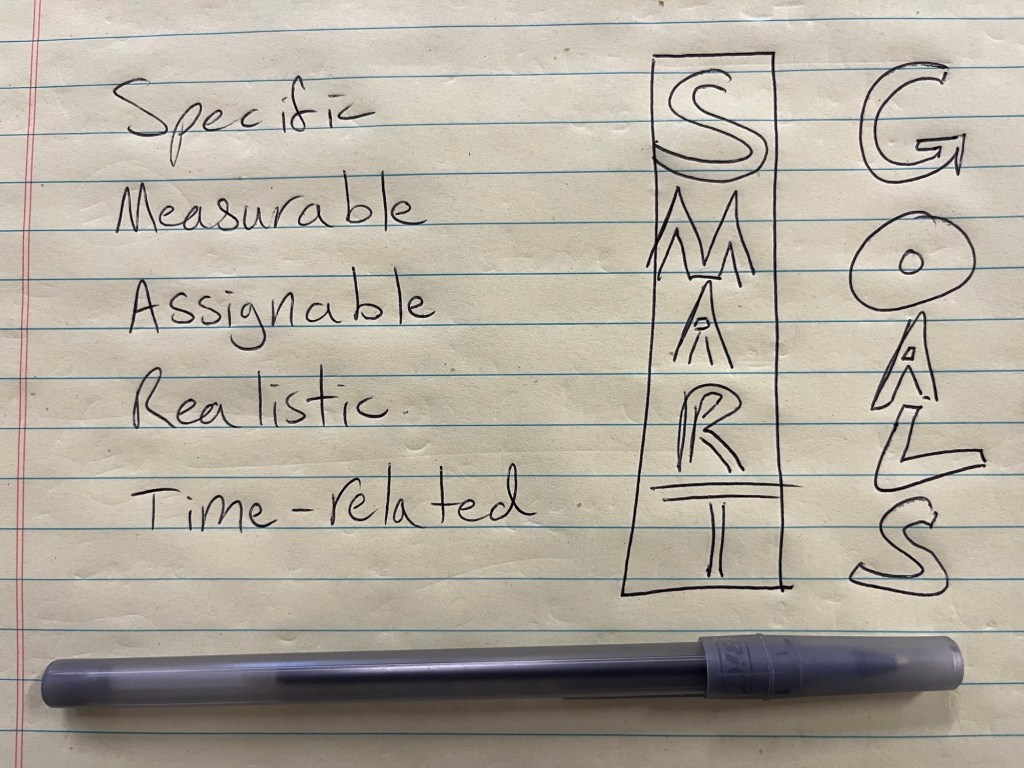
S.M.A.R.T. goals are:
Specific: What/where? (Mission Objectives)
Measurable: How? (Metrics)
Assignable: Who? (Team Lead)
Realistic: What/why/how much? (Strategic Vision)
Time-Bound: When? (Deadline)
George T. Doran (1981) listed the five “S.M.A.R.T.” goal traits as the following:
“Specific – target a specific area for improvement.”
“Measurable – quantify or at least suggest an indicator of progress.”
“Assignable – specify who will do it.”
“Realistic – state what results can realistically be achieved, given available resources.”
“Time-related – specify when the result(s) can be achieved.”
“S.M.A.R.T.” goals are ubiquitous among business, education, and health students and professionals. Some may study this template as early as High school. And many undergraduate and graduate students will be exposed to S.M.A.R.T. goals. So, why do so many professionals, businesses, and organizations fail to implement S.M.A.R.T. goals?
Out of the twelve organizations I have worked for, only one appeared to clearly communicate S.M.A.R.T. goals down the organizational hierarchy. I recall safety event charts posted on the walls of one hospital.

Above is an example of what that Intensive Care Unit (ICU) wall graphic may have looked like a decade ago. The mission, metric, and timeline are clear, but assigned rolls and other practical details, including motivational incentives, are missing. If the organization no longer posts objective quality care measures, they should. And they should improve on them.
Walking by those wall quality care charts after a late-night lunch break might have sparked the following thoughts:
(1) ‘Hospital leadership wants fewer events that harm patients…’
(2) ‘…because it aligns with the mission to do no harm to patients.’
(3) ‘And they are measuring this on a monthly basis, so they want us to beat the numbers from the last few months.’
(4) ‘But what happens if we don’t lower last month’s number? The patient is harmed and the patient, insurance, government, and/or hospital pays the bill. Who else is harmed? And who takes the blame: I guess everyone is responsible for everything? What are the consequences for me? And who is going to enforce them?
(5) ‘And is this an eternal goal? What if there are zero incidents in a handful of months or years? How do we improve that? And if we achieve a perfect record, what then: just be perfect, forever? What is next? And what do I get out of it?’
The goal was (1) specific and mission-oriented, (2) measurable as documented patient-safety incidents, and (3) time-bound as a monthly metric. That spells “S.M._._.T.”… The goal has little assignability or realism:
UnAssisgnable – ‘everyone is responsible for everything‘ (Who is the Team Lead? Who is ultimately Accountable for the outcome?): ambiguity paves the apathetic path to a mediocre life. Who inspires you more: Olympic athletes or their sedentary spectators? What do you respect more: fearful risk avoidance or courageous risk taking? The difference between stupid and courageous is common sense. And common sense suggests accountability will be difficult if everyone is responsible for everything.
Note: Teammates can switch roles. Cross-training team members improves adaptability and redundancy. But teams cannot delegate all responsibilities to everyone at the same time. Accountable teams have clearly defined roles, expectations, rewards, and consequences.
UnRealistic – ‘just be perfect, forever‘ (No Strategic Vision): Who wants to work on the same goal until you quit, retire, or die? Humans have a dopaminergic drive to achieve things. And achievements have end points. Yes, the end points are followed by another goal, and the cycle repeats itself. But destinations matter even if you don’t stay there. No one wants to look at a metric and feel like a Greek god condemned to push the same boulder up the same hill over and over again, forever (i.e. Sisyphus)…
Note: Life can feel like a meaningless, miserable, and repetitive grind. That is why Sisyphus’ task is a punishment. No one wants to do the same thing forever. Humans like a balance of familiarity and novelty. Variability helps life feel more exciting and memorable. It helps humans tell time and recall events. Variability differentiates. Variety characterizes people and defines value. Variation helps people decide what to attend to.
The other eleven organizations that I worked for missed even more of the S.M.A.R.T. goal criteria. Many of the goals had no deadline (Time-bound) or metrics (measurable). If a goal is Dull, Unassigned, Measureless, and Boundless, it is D.U.M.B…. It is missing M.A.R.T. (Measurable, Assignable, Realistic, and Time-bound). Such a goal might as well remain undefined because it is unlikely to ever be meaningfully achieved.
Sometimes there is no specific goal at all. In that case, it is no longer D.U.M.B. because it does not exist. So, goals are D.U.M.B. goals because they are missing one or all of M.A.R.T…. Remember it however you want to. Personal experience will help reveal the D.U.M.B. goals missing the M.A.R.T. from their S.M.A.R.T. And having experiences of poorly written, communicated, and tracked goals will help you avoid them in the future.
D.U.M.B. goals are infuriating. They destroy ambition and arrest progress. They stunt the growth of organizations and employees. Why should employees care about dull, unassigned, measureless, and boundless goals?
Specificity alone is useless. Put a randomized coordinate into a Global Positioning System (GPS). It will almost certainly be an outdoor location, probably in the middle of an ocean somewhere. Now tell someone to travel there.
That is specificity alone. You know the place you want to get to, but you don’t know how or why or what you will do when you get there. It is a goal without iterative steps and incentives.
“Excellent patient care!” is specificity alone because it’s so subjective. There are no metrics, leaders, strategies, or deadlines. There is no way to know what patient excellent care, how to achieve it, and why it matters to you and your coworkers.
Many organizations have an idea of where they want to go before they write out their organizational goals. So, most organizational goals are like someone putting a pin in a map and telling their people to travel there to perform a presentation that benefits the organization. “Zero adverse events this month for excellent patient care!” is like telling your people to present five times during weeklong business trip to Tokyo. It is specific (Tokyo business trip), has a metric (five presentations), and is time-bound (one week).
But these goals are still technically unassigned and unrealistic. Who is accountable for the business team? How many people are going? What is the role of each team member?
That aforementioned hospital could have rewritten its S.M._._.T. goal as:
“Leadership wants to provide excellent patient and employee care, so zero adverse events in the ICU over any one-month period will result in one day of additional paid leave for all ICU employees and a catered dinner served by your Managers, C.E.O., and C.I.O. to learn what worked. If the goal is not achieved in 60 days, an executive leadership team member will attend ICU staff team meetings with team leaders to discuss areas in need of improvement until the goal is achieved. Team members voted most responsible for improvements in patient care will be interviewed and presented with additional career development opportunities.”
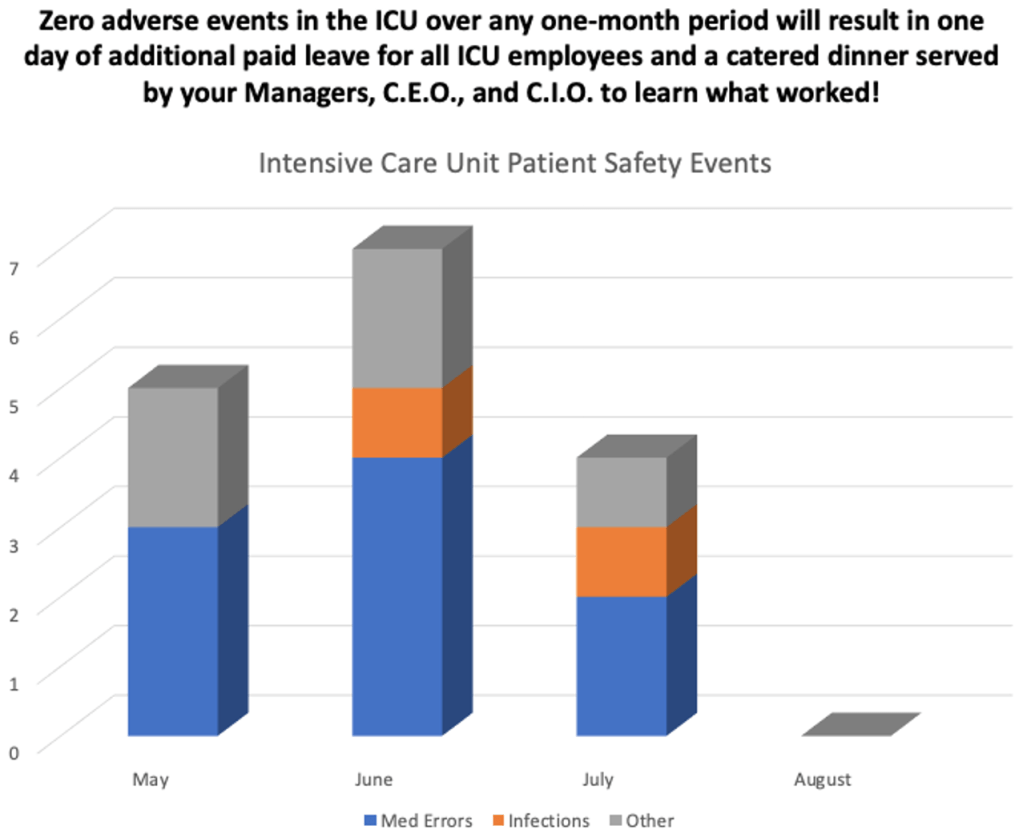
The goal is now assigned to teams led by their team leaders and realistically expects the staff to accomplish the goal once within a 60-day period. If the goal is not achieved, ongoing pursuit of the goal may prove demoralizing and be revised to make it more realistic. Along with the hospital, all patients and employees clearly benefit from this goal. The reward system is proportional and ambitious employees should be motivated by the opportunity to meet organizational leaders and advance their careers.
Of course, this S.M.A.R.T. goal alone is not enough. A team traveling to Tokyo to present five times for the benefit of their organization needs to know roles, consequences, and benefits. They also need to know the vision of the organization and the Who/What/When/Where/Why/How of the strategy to get there. Then they need to execute it.
The same is true of any hospital. Excellent patient care may be the goal. Zero adverse events may help deliver excellent patient care. But what is the long-term destination? How is the hospital planning to get there? And what part are you best fitted to play in that game?
That is what the mission, vision, values, and motto are for… And that will be the topic of the next post…
Citation:
Bjerke, M. B., & Renger, R. (2017). Being smart about writing SMART objectives. Evaluation and program planning, 61, 125–127. https://doi.org/10.1016/j.evalprogplan.2016.12.009
Doran, G. T. (1981). There’s a S.M.A.R.T. Way to Write Management’s Goals and Objectives. Management Review, 70, 35-36.

 Deliberating Truth