

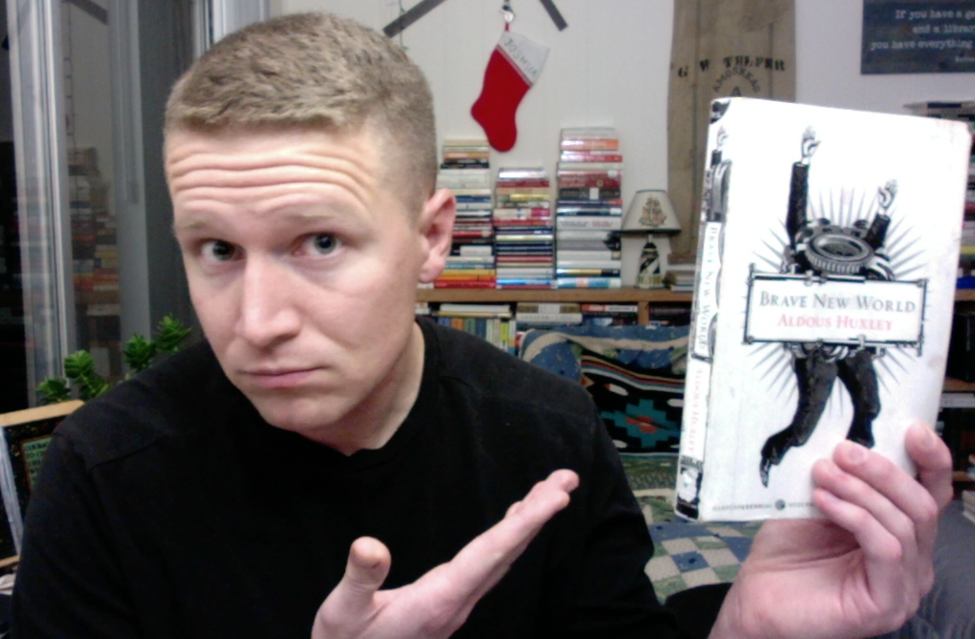
On A Brave New World by Aldous Huxley published in 1932:
Do you have the right to be unhappy? Do you have the right to reject utopia?
Aldous Huxley was an English writer and philosopher who published many other books besides A Brave New World. In A Brave New World, Huxley quickly immerses you in a world that prioritizes human happiness. One character after another is developed across sections of succinct dialogue, mini-lectures, and scene descriptions.
This book brings up a lot of questions about human civilization. The book is often labeled as dystopian, but some of the scenes feel rather ordinary. Many humans have and continue to pursue their ideas of utopia.
Could one’s utopia could be Ancient Bantu, Chinese, Mayan, or Mediterranean culture? Or, could it be an idealized model of a Jewish, Muslim, Christian, or Agnostic family? Or, could it be a long-term romantic relationship or a lifestyle that prioritizes un-romanticized short-term relationships? Could utopia be you at the age twenty-two, thirty-two, or forty-two? Is utopia anything taken to an extreme? Is utopia simply about the propagation of a state of perceived perfection.
Do you have the right to be unhappy? Do you have the right to reject utopia?
Source:
Huxley, A. (2010). Brave new world (11th ed.). Vintage.

 Deliberating Truth