

Part of the thing about reading is that you want to keep doing it. You want to keep the cascade going. You want to follow those curiosities to where they lead so that you can better educate yourself on the subjects that you’re interested in.
If you’re not interested in the subject you’re going to read more, slowly you’re going to waste time, [and] it’s not going to be the best use of your life. You want a high-quality life where you gain a lot of information that helps you apply lessons learned from books to your life.
The way to do that is by being engaged in the book, by reading with a pen in hand and writing in the margins, using the table of contents and the index to find what you want to read about, and then making sure that you go ahead and stop reading the books you’re not interested in and move on to the ones you are interested in.
Reading books is one of the best things you can do to retain knowledge and to build knowledge on specific subjects. So whether you’re interested in business, psychology, history, mathematics literature, politics, biographies, fiction, fantasy novels… whatever – humans tend to repeat the same mistakes in the past – so one of the reasons why reading is so important is to try to not repeat the mistakes your ancestors made.
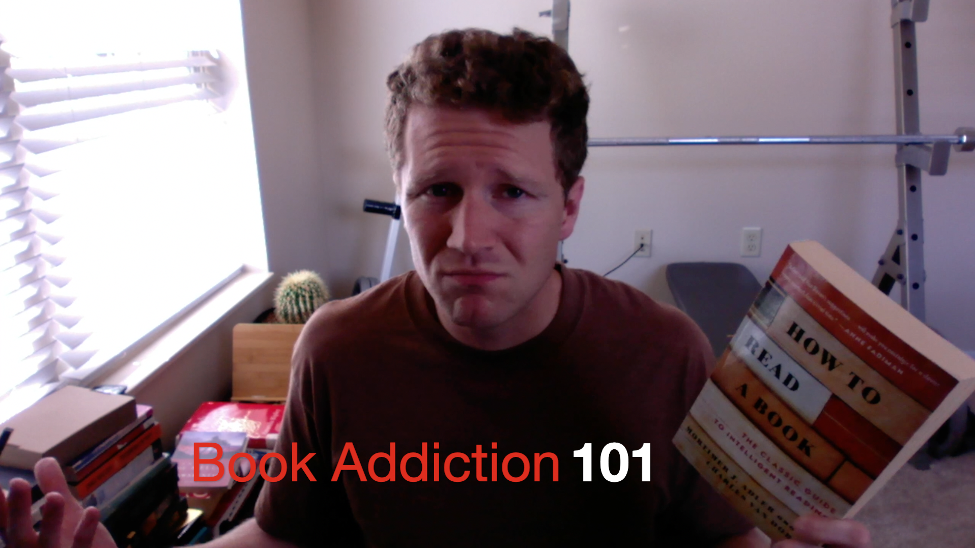
Man where did that book go? That book that was so important… it was like the key for my books. I don’t see it there… no, not there. Down here? I don’t see it. Ah, there it is. Yes! How to read a book – that’s the one.
I was just looking up this book on how to read a book. How I started reading books: in college I would try to read my textbooks and I would quit about the third or fourth week into the semester. I knew a guy I really liked and he wanted to read a book a week in a year. I really respected this guy and thought hey I should read more. So I started reading more.
And, initially, I would just get one book and I would read it. Then I would put that book on my bookshelf and save it for later because I thought if I ever want to write a book I’ll look back at the books that I read and I’ll be able to reference them so I can write my own book.
But then the addiction started and I started to feel like I needed to get books that I was going to read, not only books that I was reading at the moment. So I buy books thinking that I’ll read it later. Pretty soon I had twenty, forty, sixty, one hundred, two hundred books in my apartment that I wasn’t even reading.
And I wasn’t only reading one book at a time. I would start to pick up the books and read a little bit and then put them down – put them back on the shelf – save them for later… I went from reading one book at a time [to] reading five or ten books at a time.
But this book on how to read books actually gives a lot of good tips on what you should do if you also want to get a little bit of a book addiction. Instead of sitting and spending a lot of time in front of the television I’d much rather sit and spend time with a book. Books give me a little bit more from the time that I spend with them.
There’s just something about them that I like a little bit better – probably because my brain is a little bit more linguistic. I like words. If you’re more visual or auditory, you may find that audiobooks or television or documentaries and those types of things serve you better. But for me it’s books.
So one of the tips that this book gives you is always read with a pen in your hand and don’t be afraid to write in the margins. These are great tips that you can use to better retain information as you go through the book. In college you may use a highlighter to keep up with your readings but then you know other things start to happen and you just can’t keep up with it.
For me, I found it much easier if I just kept a pen in my hand and would underline or star or write in the margins. So I’ll show you what I’ve kind of done with this book. There’s no really rhyme or reason to it. Some people ask me like “What’s the star mean?” Well, the star just means that somethings stuck out, okay… I’m just like, oh that’s a good point, yeah, all these things give us good information. So I just starred it.
I don’t even go back and reference these a lot. When I go back into books, usually what I do is I’m looking for a specific source of information – a specific thing that I remembered in my head. So all this is doing is helping me to remember more of the book after I put it down. It doesn’t actually help me find things as much as you would think.
If I was more of a detailed person I would have like a coded system and it would all be organized by color or all organized by the symbol that I put by the words. But that’s not the way I work. When I’m going back through books all I wanna do is just see what popped out to me on the page.
If you fall asleep while you read books, writing in the margins in underlining is going to help you. The part of our brain that plans movements has a very good connection to the hand. So if you have a pen in hand, one of my favorite pens to use [is] the multicolor pen.
[If] it sticks out I can use black ink. If something is kind of like cool I can use cool blue ink. If something seems really good – like oh that’s a great point that’s a good action I want to do that – I’ll underline that in green. If something is like bad – right, I don’t wanna do that – I can underlined in red. The different colors of ink are kind of cool because it just makes it more interactive.
A really cool point that I remember from this book: it’s the highest compliment to an author of a book for you to actually write in the margins and scribble in the book and get ink all over it while you read it. They want you to read the book and think about the thoughts they thought about. Sometimes they just want to make money. So if you bought their book they don’t care what you do with it.
Don’t hesitate to ruin the book, especially if you’re going to keep it. If you want to loan it to a friend or give it back to the library I totally understand trying to keep it clean. Right, one of my friends was very offended when she saw that I go through books and I write through them. Somebody opens up a book and they see this… right, I mean that’s pretty discouraging. Nobody really wants to see that, right?
People would say like “Oh, you’re ruining the book by doing all this.” Most books get old and are going to be thrown out or burned or in the garbage within like fifty to one hundred years anyway. If you’re going to keep a book over the course of your lifetime, you might as well write in it.
If the only thing you get out of writing in the margins and making a mess of your book is that you didn’t fall asleep, you’re going to do a better job of actually getting through that book. If you read with a pen in hand you’re going to fall asleep less and you’re probably going to retain more. And that knowledge is going to help you as you advance through life.
You know, the thing that you got to do with books too besides writing in the margins is looking stuff up in the table of contents. So, one, write in the margins. Two, use the table of contents and the index to find information.
Even if you just want to scan a book, you want to look at the table of contents. You can go through and skim: read the chapter titles and look at the headings in the chapter – that’s why they’re there; to help you go through it quicker – so that you can see if you actually want to read this book [and] if you’re interested or not. If something sticks out to me, I’ll go ahead and write in the table of contents.
There’s also the index of the book. So if you’re going through a book – if you don’t remember where the thing was at – you can go back to this part where it lists the page. Okay, so it’s got a bunch of different words. It’s like a Dictionary. You look up the word that you want. It’s called the index.
So let’s review. Read with a pen in hand. It keeps you awake and you pay more attention and you retain more information. Don’t be afraid to use the table of contents and the index to find information. Number three is a tip that I’m pulling from another author that I really like.
If you don’t like a book, stop reading it. I really like that tip because you can get caught up thinking I need to finish this book, I need to finish this book. You do not have an obligation to the author to finish their book once you start it.
What I’ve found is that a lot of books are unnecessarily long. The information that they contain in the book is pretty much explained in the title itself. It’s not a complicated subject. And the more you read books on certain subjects the more you’re going to run into other books that repeat information that you’ve already heard in the books that you already read. So, you’re not going to need to read the whole book all the time.
If you read one hundred – two hundred – three hundred books, you’re going to start running into information that you already read and you already know. That information is repeated just because humans tend to repeat the same things over and over again. If it’s not entertaining – set it down, return it to the library, whatever you need to do – you don’t have to finish it. That will help you spend more time with the books that you really want to read.
If you want to know how to read more books, number one, use a pen [and] don’t be afraid to write in the margins. It will keep you awake and help you retain more of what you read. Number two, use the table of contents and index to look up information. Don’t be afraid to scan the book before you decide if you want to read it. And, number three, – from Nassim – don’t be afraid to set the book down. If it’s not entertaining, forget it. You don’t need to read it. You have no obligation to the author to finish the book. This will help you move on to information that you’re more curious about. It will keep you engaged in reading.
So that – in a nutshell – is how to read more books.
Citations:
Adler, M. J. (1940). How to read a book (6th print). Simon and Schuster.
Taleb, N. N. (2008). The black swan. Penguin Books.

 Deliberating Truth