

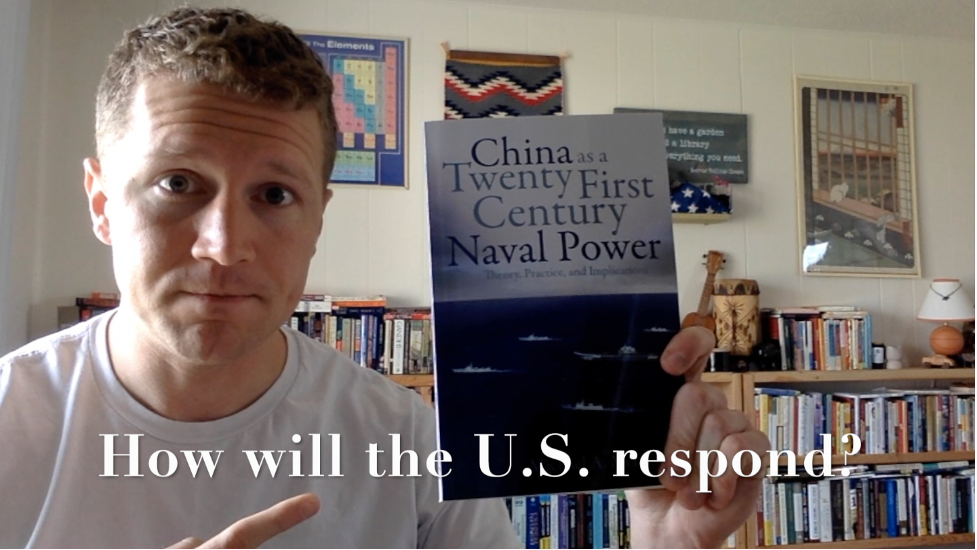
On China as a Twenty First Century Naval Power by Michael McDevitt published in two thousand twenty three:
Three things stuck out: (1) “blue-water” navies, (2) island chains, and (3) asymmetric capabilities.
Michael McDevitt is a retired Rear Admiral with 34 years of experience in the U.S. Navy. McDevitt covers China’s naval units, capabilities, and ambitions in detail. His analysis is broad and specific.
China is building a navy to sustain long-term operations in foreign oceans. These “blue-water” navies require significant support from friendly ports and/or ships. “Blue-water” navies require a diverse collection of capabilities and resources. They need additional protections and supplies.
China is expanding its influence to feed its growing economic and geopolitical ambitions. China’s wish-list appears to include Taiwan and the first island chain, followed by the South China Sea, and the second island chain, which includes Guam. Appearances can be deceiving, but China’s three aircraft carriers, ballistic and cruise missile systems, and accelerated ship building industry suggest it will outnumber the United States Navy by 2035. How will the United States respond?
Citations
McDevitt, M. (2020). China as a Twenty-First-Century Naval Power: theory, practice, and implications. https://openlibrary.org/books/OL30203200M/China_As_a_Twenty-First-Century_Naval_Power
Paulson Institute. (2015, January 28). RADM Michael McDevitt, US Navy (Ret.): “China’s Maritime Strategy and the Future of Asia” [Video]. YouTube. https://www.youtube.com/watch?v=MPoVJ9DeSzM
Image Links
https://www.youtube.com/watch?v=MPoVJ9DeSzM
Rim of Pacific (RIMPAC) Exercise (Evans, 2006)

Wikicommons (2023)

Liaoning Aircraft Carrier (Wikicommons, 2022)
_20220516.jpg)

 Deliberating Truth