

I was recently watching Andrew Huberman interview Justin Sonnenburg, coauthor of The Good Gut (2015), when Sonnenburg said, “It kind of gets back to Michael Pollan’s mantra, eat food not too much mostly plants. I think if you stick with these simple rules… it makes it very approachable.”
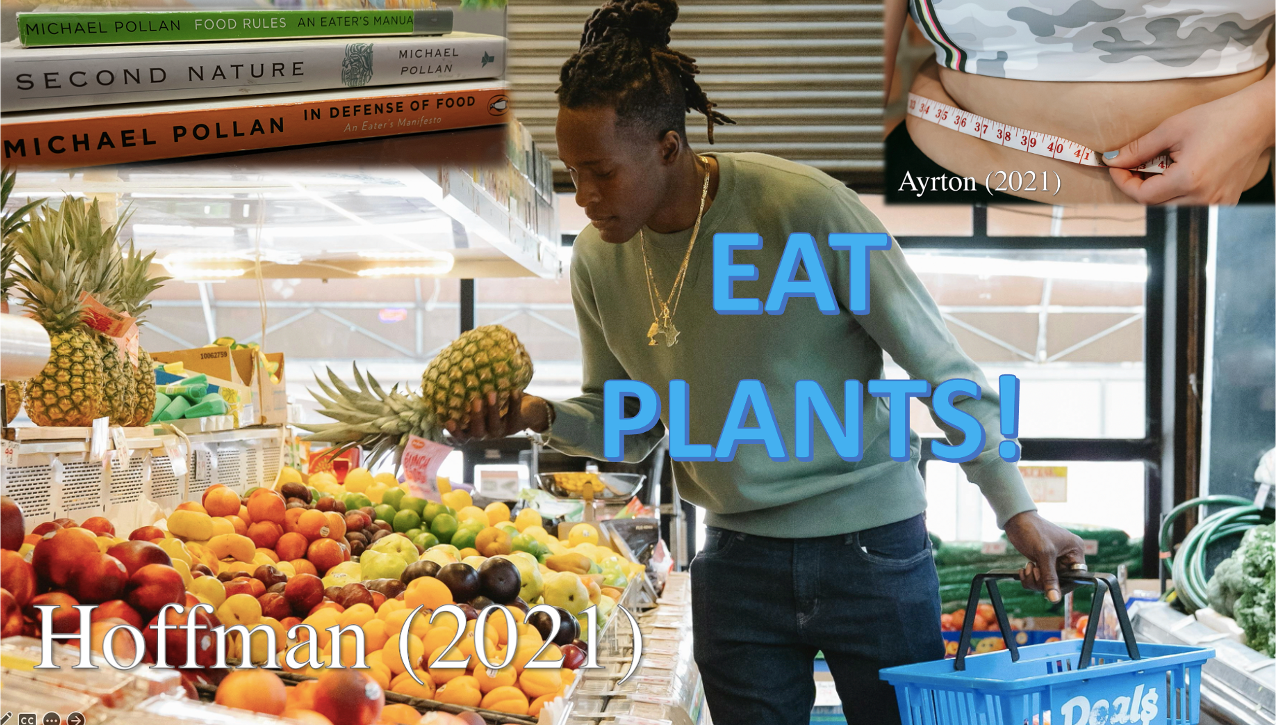
Michael Pollan is a Journalist who has written a number of books about food. In Food Rules (2009) Michael Pollan gives the following advice, “Eat Food, Not Too Much, Mostly Plants.” But what does Pollan mean when he says eat food?
“Eat food…”
Most fresh foods tend to be located in or around cold-chain machines connected to supermarket walls. There are unhealthy foods that are frozen or refrigerated. But a lot of processed and unhealthy foods are on shelves located closer to the center of the store.
Processed foods are not fresh foods. Healthy foods rot when they are consumed by other living things like insects and microorganisms. Processed foods are often stripped of nutrients, filled with preservatives, or both… Processed foods are preserved so they can be consumed for their calories at a much later date.
Processed foods have shelf-life which allows them to be stored for longer periods of time. This allows humans to preserve food for emergencies and disaster scenarios. Processed foods keep humans from starving. Processed foods also allow businesses to save money by storing products for longer periods of time.
“…not too much…”
Humans can survive on processed foods, but humans need nutrients to be healthy. Chronic overconsumption of processed food can lead to malnutrition and metabolic syndrome. It’s possible to eat too much fresh food. But processed foods are often more likely to fatten people up and slow them down. So, it’s wise to avoid overconsumption, especially of processed food.
“…mostly plants.”
Sonnenburg says, “There’s a very simple recipe and really well-accepted broad definition of what a healthy diet is…the Mediterranean Diet, plant-based diet… If you can have a high-fiber, plant-based diet…for most people… you don’t really need to think about other things…”
So, “Eat food, not too much…” is less relevant than “…mostly plants.” It’s easier to avoid processed foods if one’s daily nutrition needs are met. And plants have most if not all of the nutrients that humans need.
Avoiding processed food does not guarantee that one’s nutrition needs will be met. Eating a variety of fruits, vegetables, legumes, whole grain, and nuts delivers nutrients to the human body. Saying “yes” to hundreds of nutritious foods may be easier than saying “no” to thousands and thousands of processed foods. Processed foods may lack essential nutrients and contain excessive amounts fat, salt, and/or sugar. So processed foods can give people too much of the bad stuff and too little of the good stuff. If people just focus on eating a wider variety of high-fiber, low-sugar plants, they will have less time, money, attention, and effort to spend on processed foods.
Sonnenburg says, “If you prioritize getting a huge amount of whole plant-based food with a lot of fiber first you’re not going to have room for eating a lot of processed food. So it’s kind of the same as avoiding processed food.”
Later in the podcast Sonnenburg says, “Most people would reap tremendous health benefits from eating more whole, plant-based dietary fiber.” Eating a variety of low-sugar, high-fiber plants seems like a difficult thing to do in the United States of America. But it may be one of the most important things people can do to improve their health.
So, the best nutrition advice may simply be: eat plants!
Citatons:
Andrew Huberman. (2022, March 7). Dr. Justin Sonnenburg: How to Build, Maintain & Repair Gut Health | Huberman Lab Podcast #62 [Video]. YouTube. https://www.youtube.com/watch?v=ouCWNRvPk20
Food Rules: An Eater’s Manual by Michael Pollan (2009)
The Good Gut: Taking Control of Your Weight, Your Mood, and Your Long-term Health by Justin Sonnenburg and Erica Sonnenburg (2015)
Ayrton, A. (2021, January 11). Woman measuring her waist. pexels.com. https://www.pexels.com/photo/woman-measuring-her-waist-6551075/
Hoffman, G. (2021, August 5). Man in grocery store picking pineapple. pexels.com. https://www.pexels.com/photo/man-in-grocery-store-picking-pineapple-9705816/
Hoffman, G. (2021, August 5). Vegetable stall at supermarket. pexels.com. https://www.pexels.com/photo/vegetable-stall-at-supermarket-9705830/
Industri, H. (2020, March 30). Photo Of Woman Pushing Cart. pexels.com. https://www.pexels.com/photo/photo-of-woman-pushing-cart-4053267/
Latorre, J. (2020, November 18). A Woman Getting Cereal Boxes from the Shelf. pexels.com. https://www.pexels.com/photo/a-woman-getting-cereal-boxes-from-the-shelf-9321466/
Patrascu, I. (2020, January 28). spoiled orange beside cinnamon. pexels.com. https://www.pexels.com/photo/spoiled-orange-beside-cinnamon-3640474/
Ramonaite, V. (2021, February 18). Assorted Food Packs on White Shelves. pexels.com. https://www.pexels.com/photo/assorted-food-packs-on-white-shelves-6865456/
Stebnicki, M. (2012, June 8). Pile of Assorted-varieties of Vegetables. pexels.com. https://www.pexels.com/photo/pile-of-assorted-varieties-of-vegetables-2255935/
Xu, J. (2019, October 4). Assorted Bottles and Cans in Commercial Coolers. pexels.com. https://www.pexels.com/photo/assorted-bottles-and-cans-in-commercial-coolers-3028500/

 Deliberating Truth